
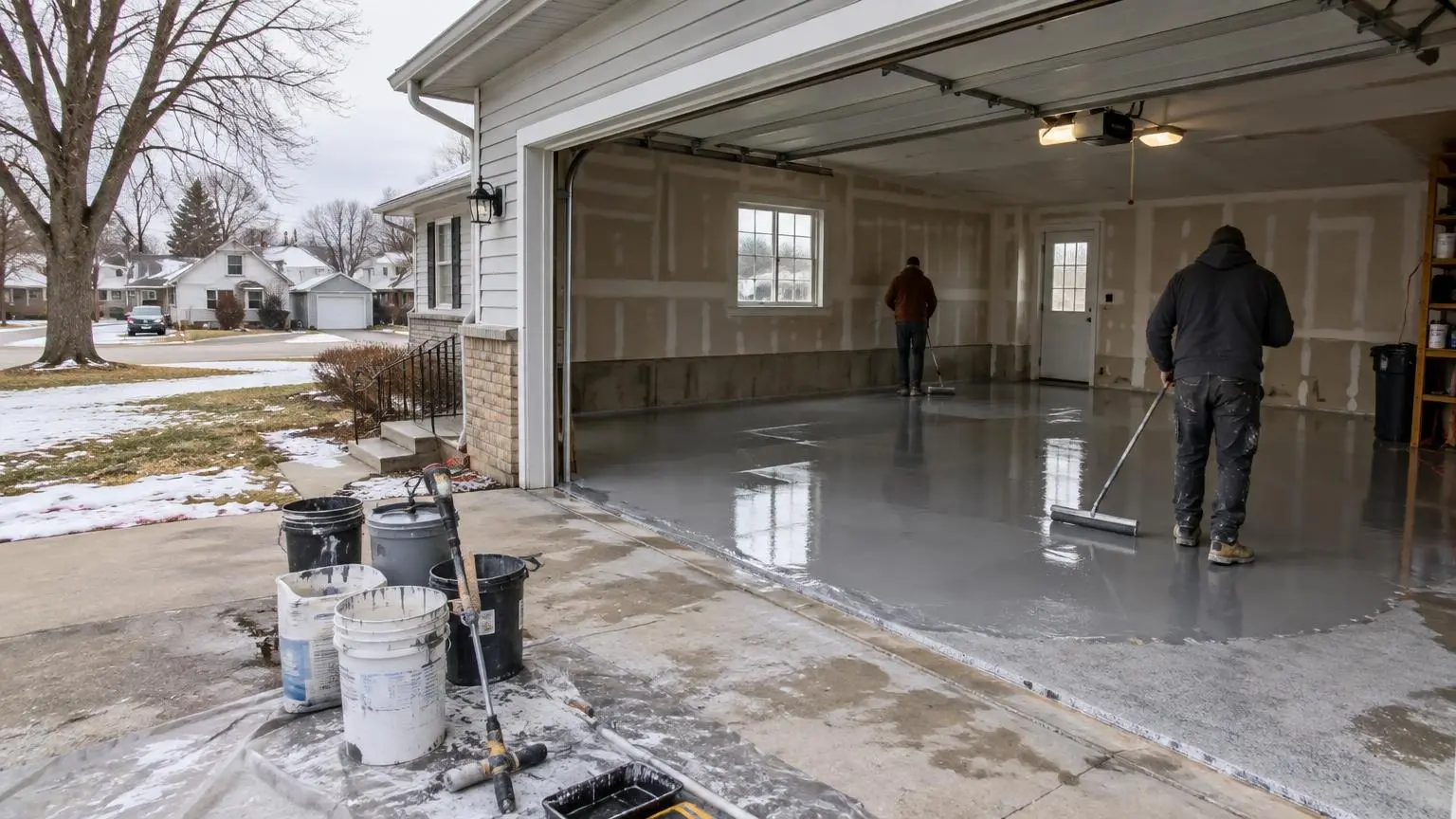
Garage, basement and shop floors in the Cedar Valley
Epoxy Flooring in Waterloo, IA
Resin floor coatings for salted garages, older basements and working shops, laid over diamond-ground concrete.
- Free on-site estimates with a slab moisture check
- Itemized written quote before any grinding starts
- Every floor diamond ground and patched before it is coated
Floor Coatings Built for Cedar Valley Concrete
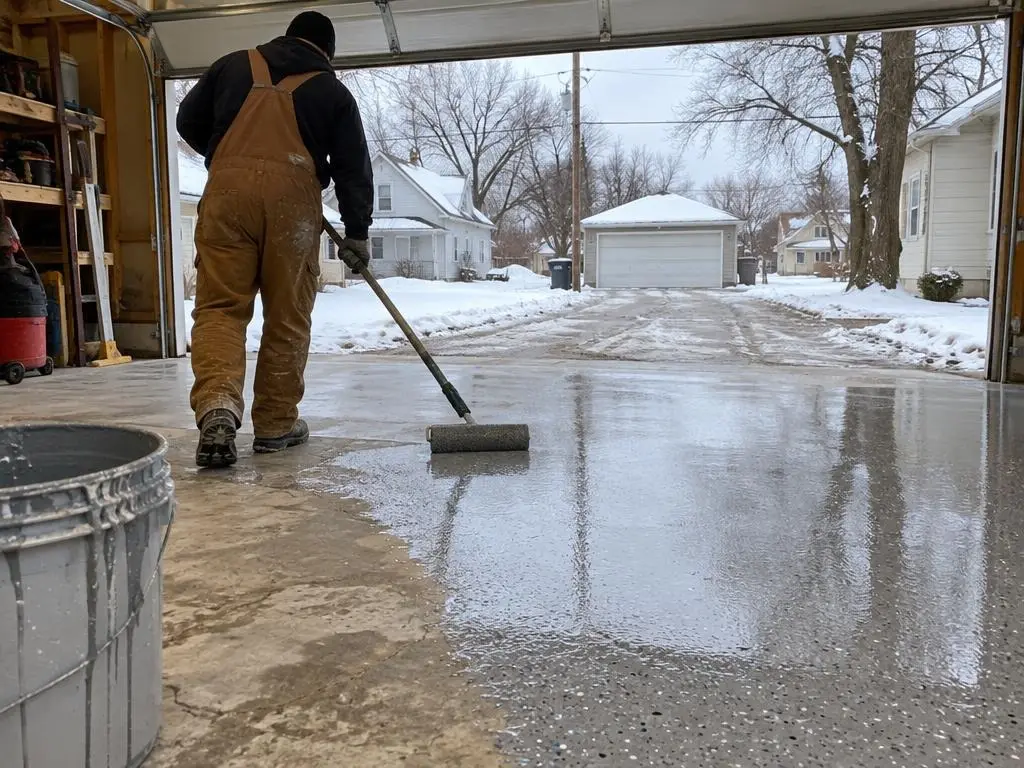
Epoxy flooring in Waterloo, IA mostly starts in the garage. Waterloo's January normal mean temperature is 18.5°F, and the city averages about 35 inches of snow a winter, according to Wikipedia's climate figures. From the first storm to the spring thaw, cars roll in carrying slush and road salt, and the meltwater sits on the slab. Bare concrete soaks it up. A bonded resin coating keeps it on the surface, where you can push it out the door with a squeegee. That is the main job we do in Waterloo and Cedar Falls.
A city of older slabs
Waterloo grew as a factory town. John Deere has built products here since 1893, when the Waterloo Gasoline Engine Company began making the tractor later sold as the Waterloo Boy, and the city still goes by the nickname Factory City. Much of its housing went up during those working decades. American Community Survey estimates for 2019 to 2023, published by Point2Homes, show that 21.6% of Waterloo's housing units were built in 1939 or earlier and another 26% between 1940 and 1959. The median year built is 1962. Cedar Falls is younger, with a median year built of 1975 and about a quarter of its homes built since 2000.
An older slab is often thinner, more cracked and more patched. Detached garages from the 1940s and 1950s may slope toward a floor drain or settle at one corner. Basements may carry decades of paint. None of that rules out a coating. It does mean we look at the floor before we put a number on it, because two garages of the same size can need very different prep.
Salt, freeze and thaw
The first four feet inside a garage door take the worst of an Iowa winter. Meltwater pools there, refreezes when the door opens, and thaws again when the car warms the space. Over several winters bare concrete in that strip starts to flake, pit and turn powdery. A coating stops new damage, but it cannot bond to concrete that is already crumbling. We grind past the weak surface and fill the pits before the base coat, so the coating sits on sound concrete.
Basements, moisture and radon
Many Waterloo homes have full basements. Moisture moving up through a basement slab is the most common reason a basement coating blisters, so we test before recommending a system. Where we find moisture, we use a moisture-tolerant primer or tell you the water source needs fixing first. Radon is the other basement issue in Iowa. The Iowa Department of Health and Human Services says Iowa has the largest percentage of homes above the EPA action level of 4 pCi/L, at 71.6%, and the whole state is EPA radon Zone 1. A floor coating is not radon mitigation, so we suggest testing before you finish a basement.
Systems we install
- Garage floor coatings: a thick epoxy base, flake or solid color, and a clear topcoat that stands up to brine and hot tires.
- Flake floors: colored vinyl chips broadcast into the base coat to hide salt film and add grip.
- Polyaspartic coatings: fast-curing coats that can go down in cold weather and let you park sooner.
- Basement floor epoxy: coatings matched to the moisture level of the slab, including metallic finishes for rec rooms.
- Shop and commercial floors: heavier 100% solids systems for workshops, machine sheds, service bays and warehouses.
- Crack and floor repair: filling, patching and grinding so an old slab can take a coating.
What happens on a typical garage job
- We agree on what moves out and where the cars go during cure time.
- The floor is checked for moisture, oil, salt residue, old paint and cracks.
- The whole slab is diamond ground and vacuumed.
- Pits, spalls and cracks are filled and ground flush. Control joints can be filled or left open.
- Base coat, flake or color, and topcoat go down over one or two days.
- You get written timing for walking on the floor, moving storage back and parking.
Working through an Iowa winter
Resin coatings need the slab and the air warm enough to cure. Each product lists its own limits. In cold months we check the slab temperature, may heat the space, and lean toward polyaspartic, which HomeGuide lists with an application range of -30°F to 140°F. If conditions are not right for the system you want, we tell you and pick a better week.
Why Homeowners Call Waterloo Epoxy Flooring Pros
Ground, never just etched
Every slab is diamond ground so the resin bonds to open, sound concrete. Acid etching alone leaves salt-weakened surface and old sealers behind.
Moisture tested first
Basements and slabs on grade are checked before we recommend a system, so the coating matches the floor.
Built for salt season
Garage floors get seamless, chemical-resistant topcoats and texture so brine stays on top and the floor has grip when wet.
One written price
Your quote lists square footage, prep, every coat and the total. Any added work is written up for your approval first.
Where We Work
Waterloo and Cedar Falls are the center of our area. We also coat floors in Evansdale, Elk Run Heights, Raymond, Gilbertville, Hudson, La Porte City and Dunkerton in Black Hawk County; Waverly, Denver and Janesville in Bremer County; Dike in Grundy County; and Parkersburg and New Hartford in Butler County. Conditions shift across that map. Waterloo's older neighborhoods have more detached garages and basements with decades-old concrete. Newer subdivisions in Cedar Falls, Hudson and Waverly have larger attached garages with younger slabs that still face a full season of salt. Small towns and farm places bring more machine sheds and shop floors. Each area page covers what we know about floors there.
- Epoxy Flooring in Waterloo, IA
- Epoxy Flooring in Cedar Falls, IA
- Epoxy Flooring in Evansdale, IA
- Epoxy Flooring in Elk Run Heights, IA
- Epoxy Flooring in Raymond, IA
- Epoxy Flooring in Gilbertville, IA
- Epoxy Flooring in Hudson, IA
- Epoxy Flooring in La Porte City, IA
- Epoxy Flooring in Dunkerton, IA
- Epoxy Flooring in Waverly, IA
- Epoxy Flooring in Denver, IA
- Epoxy Flooring in Janesville, IA
- Epoxy Flooring in Dike, IA
- Epoxy Flooring in Parkersburg, IA
- Epoxy Flooring in New Hartford, IA
Our Epoxy Flooring Services
Six services for the floors we see most in the Cedar Valley: salted garages, older basements, farm and work shops, and slabs that need repair first.
Garage Floor Coating
A full-slab resin coating for Cedar Valley garages, laid over ground and patched concrete so winter slush stays on the surface.
Learn more →Epoxy Flake Floors
Full-broadcast flake floors that hide salt film and add grip, in color blends picked on site.
Learn more →Polyaspartic Floor Coating
Fast-curing, UV-stable coatings you can park on sooner, with a wider temperature window for Iowa's cold months.
Learn more →Basement Floor Epoxy
Basement coatings chosen after a moisture test, from simple sealed floors to flake and metallic finishes.
Learn more →Shop & Commercial Floor Epoxy
Heavier resin systems for workshops, machine sheds, service bays, warehouses and food-handling floors.
Learn more →Concrete Crack & Floor Repair
Crack filling, spall and pit repair, and leveling patches that get an old or salt-worn slab ready for a coating.
Learn more →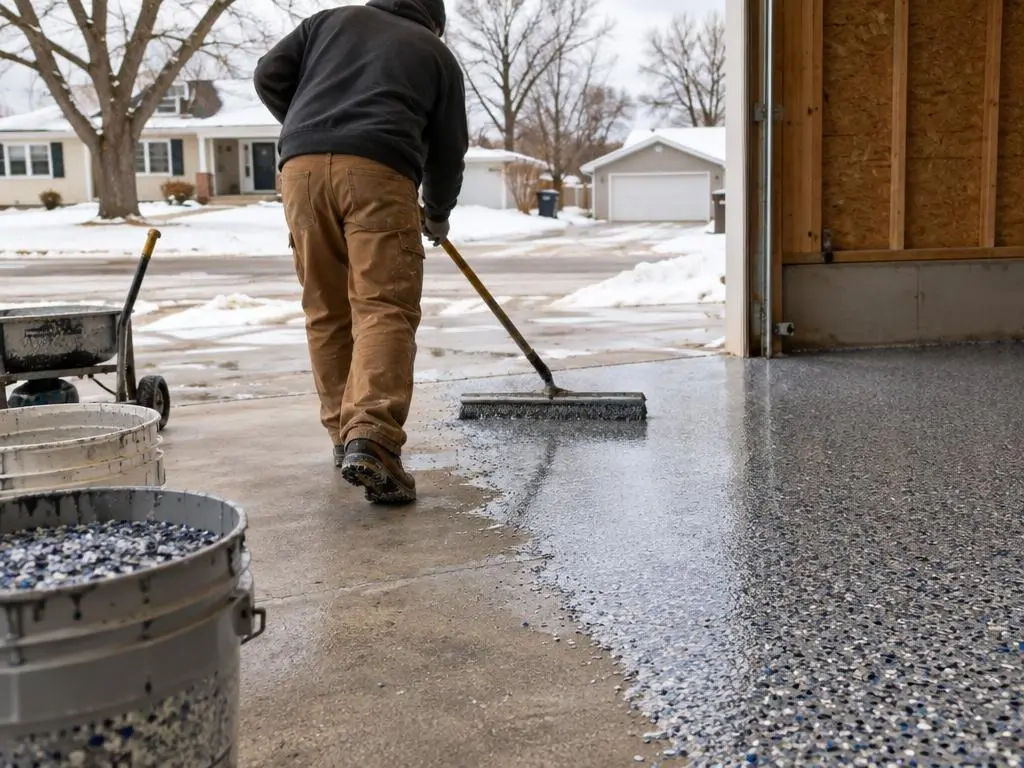
Common Questions
How much does epoxy flooring cost in Waterloo, IA?
HomeGuide's national range for installed epoxy is $4 to $10 per square foot, or about $1,600 to $5,800 for a two-car garage. Polyaspartic runs $5 to $12 per square foot in its companion guide. Salt damage, old paint and crack repair push a floor higher, so we give you a written price after seeing it.
How much does it cost to epoxy 1,000 square feet of flooring?
At HomeGuide's $4 to $10 per square foot, 1,000 square feet comes to roughly $4,000 to $10,000 for epoxy. A polyaspartic or full flake system on the same area runs higher. Big open shop floors often cost less per foot than small, cut-up rooms.
How much would it cost to epoxy a 600 square foot floor?
Using HomeGuide's ranges, 600 square feet works out to about $2,400 to $6,000 for epoxy and $3,000 to $7,200 for polyaspartic. That is about the size of a large two-car or small three-car garage. Prep and repairs move the number within that range.
What is the downside of epoxy flooring?
Epoxy needs a dry, clean, ground slab, and it peels where moisture, oil or old sealer is left underneath. Standard epoxy cures slowly and can yellow in sunlight without a UV-stable topcoat. A smooth glossy floor is also slick when wet, which matters with snowmelt. Each of these is handled with the right prep and topcoat.
Is a store-bought epoxy kit good enough for an Iowa garage?
HomeGuide prices premade kits at $200 to $700 and says water-based epoxy lasts about 3 to 5 years. Most kits depend on acid etching, which does not remove salt-damaged concrete or old coatings. On a garage that sees road salt every winter, the prep is what decides how long the floor lasts.
Can you coat a garage floor in the winter?
Often, yes. We check slab temperature, can heat the garage, and usually choose polyaspartic for cold-weather work because it tolerates a much wider temperature range than standard epoxy. If the conditions are wrong for your system, we schedule a warmer window.
Get an Epoxy Flooring Estimate
Free on-site estimates in Waterloo, Cedar Falls and across the Cedar Valley.